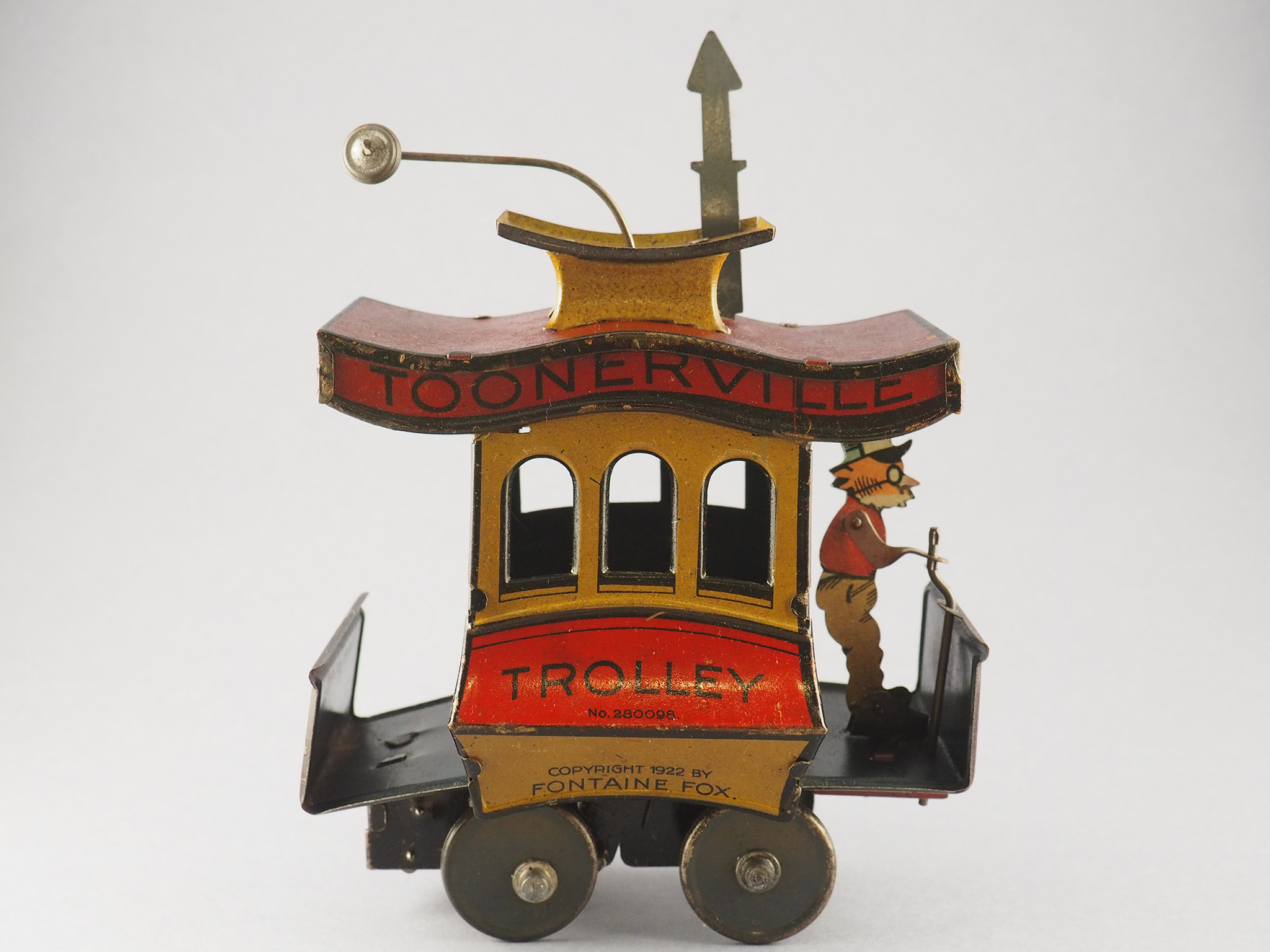
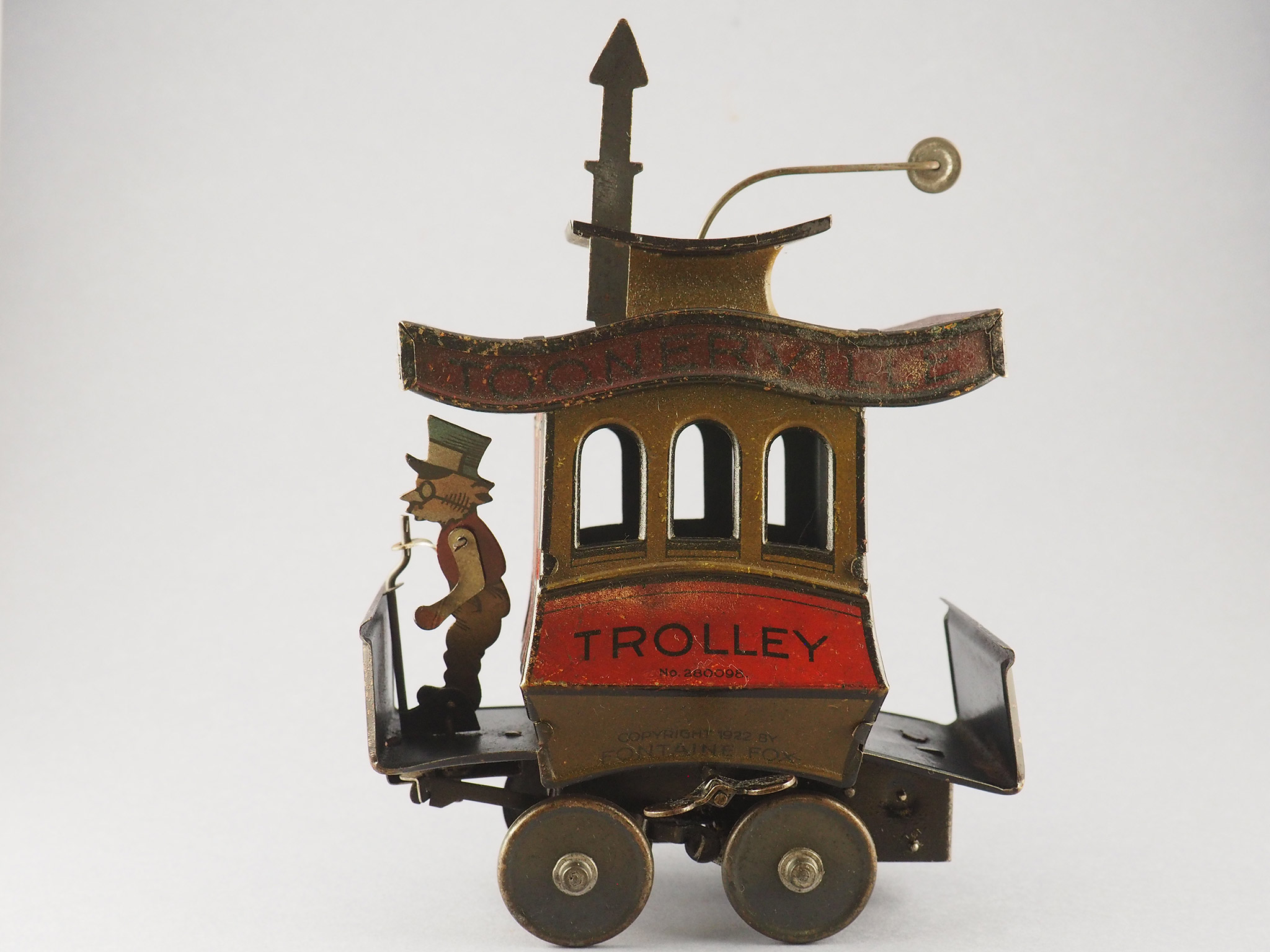
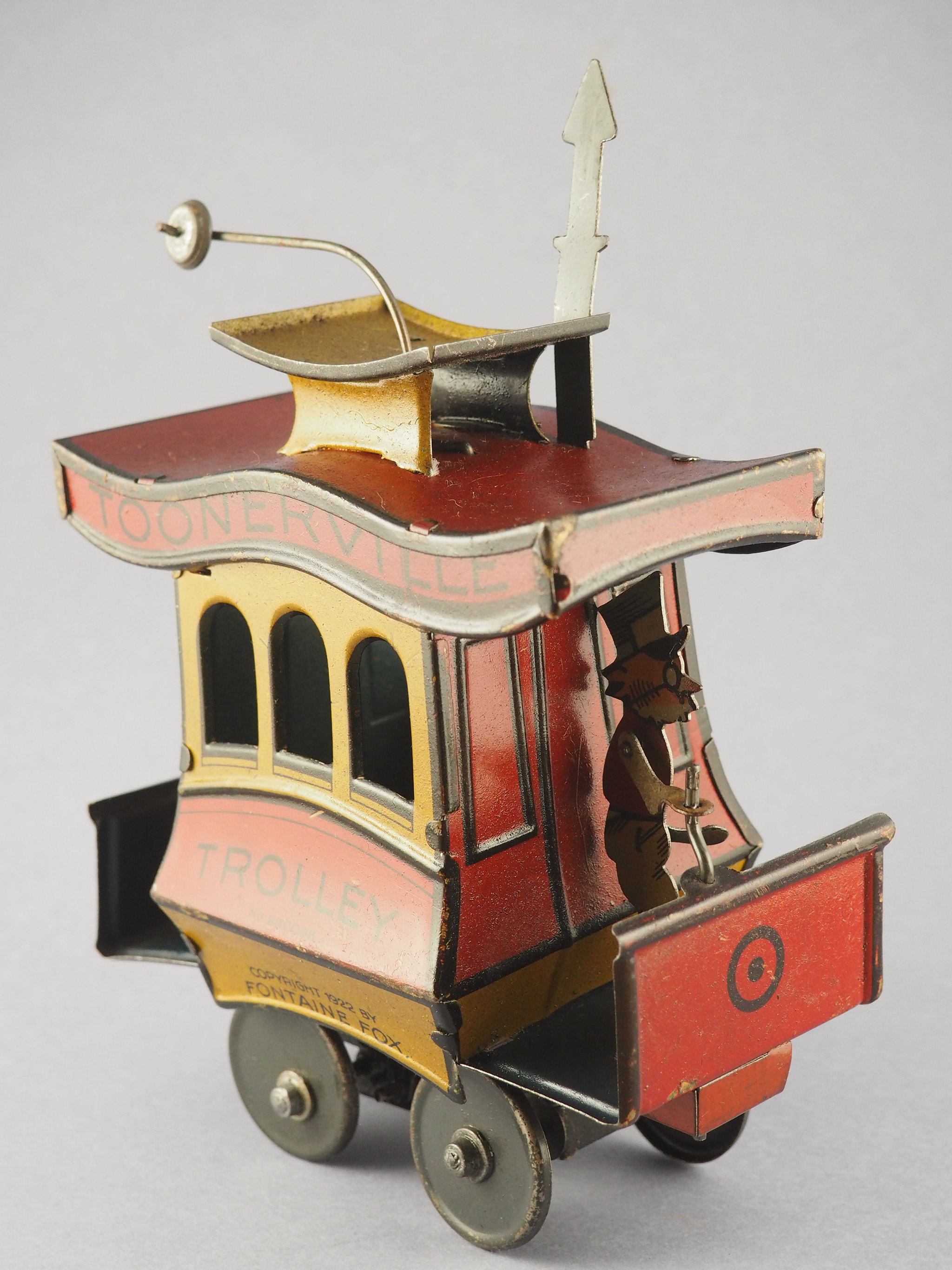
Toonerville Trolley
Fischer, HComical Trolley w/ driver
- Model
- 6-310-50
- Type
- Vans / Buses & Trucks
- Topic
- Character
- Country of manufacture
- Germany
- Mechanism
- Clockwork
- Movement
- Toy wobbles as it moves forward, driver moves forward and back and steers. The trolley stops, the driver rotates the tiller in opposite directions until the trolley moves again.
- Materials
- Tin
- Dimensions (LxWxH cm)
- 12.5x7x18
- Condition
- Very Good
- Manufactured
- 1922 – 1929
- Box
- Reproduction box (too small, probably for one variant of this toy)
Research notes
Fontaine Fox was a popular American cartoonist, with the Toonerville Trolley as a syndicated cartoon featuring a trolley with "Skipper" at the helm. Some feel that Fontaine's inspiration for the Trolley was based on a Trolley Ride he took through Pelham New York in 1909. F.F. continued this comic strip until 1955 when he retired. Marked Trolley No. 280098, G.M. 33967 and D.R.P. 257554 (1912). Distributed in the USA by Nifty. There are four toy variants, 3 made in Germany in the mid-1920s by H. Fischer, Nuremberg, and a fourth was made in Japan, maker unknown, probably circa 1930. Variant 1 is the most common (our toy). The mechanism involves stop-and-go and shaking and an eccentric axle with offset wheels that cause the toy to wobble as it moves forward. The Skipper holds the tiller in one hand, which is connected by a rod to the mechanism, so that when the trolley moves forward the Skipper moves forward and back and the tiller is moved as if he is steering. The second variant has a simpler mechanism: it has an offset wheel so that it does wobble, but the Skipper’s arm is not connected to the mechanism. To create movement around the Skipper, he is placed on a spring. No electric take-up wire on the roof, and slightly smaller box. The third variant is designed to run on railroad tracks. It sold in a bigger box that included the track. The Japanese variant was made circa 1930 and was larger. Same markings and copyright date 1922, but just above the Skipper’s head on the roof canopy it reads “Made In Japan.”